Leo Gorcey Jr. and his wife, Krista, are producing a film based on Leo’s book, “Me and the Dead End Kid.” The book chronicles Leo Gorcey Sr.’s theater and film career, the Gorceys’ unique family relationship, and the dramatic events leading to the original Broadway production of Sidney Kingsley’s “Dead End.”
The film is in development with plans to shoot in the Rogue Valley. I visited the Gorceys in their attractive Ashland home.
Shae Johnson is now starring as Suzy in Oregon Cabaret Theatre’s “Winter Wonderettes.” Johnson studied opera at the San Francisco Conservatory of Music after graduating from Ashland High School. Returning to Ashland, she performed in the Oregon Shakespeare Festival’s “The Music Man” and in OCT’s “The Marvelous Wonderettes.” She played Debbie Reynolds in Oregon Cabaret Theatre’s “What a Glorious Feeling.” Johnson is now the lead singer of the Rogue Suspects. We met for coffee at Mix Sweet Shop in Ashland.
SJ: I love live theater; I love being in front of an audience, which is very different from being in front of a camera. A camera just stares at you without any emotion. With an audience, it’s very in the moment; every show is different, because you have a different audience every night.
The goal of the actor is to be able to communicate to the audience, to make them feel what you’re feeling and have them relate to what you’re feeling on stage. You can see it. Sometimes when you look out into the audience, you can see when there’s someone in particular who is understanding what you’re doing. As long as there is just one person in the audience who is really loving it, that’s enough for me.
Peter Quince played Roger Sherman in “1776” last summer at the Camelot Theatre. He later played Charlie in David Ives’ “Mere Mortals” at Ashland Contemporary Theatre. Now Quince is launching his own musical comedy, collaborating with composer David Gabriel, called “Divine Lunacy.” Quince and I met at Noble Coffee.
EH: You’re working on a new musical?
PQ: “Divine Lunacy” was done as a sketch comedy review in 2006 with two sold-out performances at the Black Swan Theatre. It was wildly and enthusiastically received. People thought it was both hilarious and thought-provoking. It deals with the whole notion of the line between divine inspiration and out-and-out lunacy. As any artist probably knows, you may cross that line over and over again. If you come back, it’s OK. If you stay across that line, it could be a problem, and you have to be locked-up, or at least helped in some way.
Where is the line? How easy is it to cross? What’s the role of the artist in society? Many prominent artists in the last decade have been praised and lionized. Artists are encouraged to let themselves go over that line. Suddenly they have gone over the line, and they’re really troubled. “Divine Lunacy” talks about all of that in the context of a strong, heartwarming and funny show.
Mental illness has become extraordinarily prevalent. There are some estimates that one out of four people, at some point in their lives, are on psychiatric medication. It’s a huge issue in our society, but it’s not often dealt with openly, and certainly not with comedy and music, which is a gentler way to open people’s hearts and minds, making them feel and think, by making them laugh and care. “Divine Lunacy” shows what it’s like to be in the midst of crises or bouts of incredible creativity.
When is it, the divine spark? And when is it the infernal fire? It starts the same way, and it looks the same. We need that divine spark. We need to make it come to life, but it can consume as well as it can illuminate.
Actor, director and associate professor Jackie Apodaca directed Jose Rivera’s “Marisol,” which is playing this week at Southern Oregon University’s Center Stage Theatre. The production’s sensational staging, ensemble acting and stage movement blend bizarre and beautiful elements to create a compelling theatrical experience. Jackie and I met over breakfast at Greenleaf Restaurant in Ashland.
EH: What is unique about the theater experience?
JA: It is the live experience of it. Everyone is experiencing the exact same moment and will have the shared experience. There is something exciting about that fleeting and momentary experience. And you experience it as the actor, as the director, as the stage manager, as the run-crew, and as the audience. The experience is so close and intimate between the audience and the performers in that way.
Whereas in film, everyone experienced something, and then someone took it away, changed everything about it, and brought it back and showed you what it was. Film seems more intimate in that you see the actor’s face close up, but it has gone through so many processes before you got to see it. Did you really get to see what they did? Probably not.
I worked with filmmakers when I taught in the Film and Media Department at the University of California, Santa Barbara. I loved that, but film is completely the medium of the director and the editor. We would change the actor’s performance in the editing room. And we would talk about how we could make them seem to be doing different things. There is so much that can be controlled outside of the actor and outside of the moment. In post-production, the moment is gone and completely changed.
Scott Kaiser is directing a new adaptation of Chekhov’s “Three Sisters” by former Oregon Shakespeare Festival Artistic Director Libby Appel. It opens Nov. 8 at Southern Oregon University’s Center Stage Theatre in Ashland. Kaiser is director of company development at OSF.
EH: How is acting in a Chekhov play different from acting in other plays?
SK: The two playwrights who are most revered by actors are Shakespeare and Chekhov. The reason is that they are so rewarding.
Everything you pour into Shakespeare, as an actor, as a director, as a designer, you get back. That is not something you can say about every playwright.
Most actors will tell you that they will travel anywhere and take any pay in order to work on Chekhov or Shakespeare. On a fundamental level they understand human nature so deeply that the roles are bottomless as you start to explore them.
The major difference between Shakespeare and Chekhov is that Shakespeare is much more forthcoming on the page about what the character is thinking or feeling. The characters often say exactly what is on their minds, and they often say exactly what they are pursuing in terms of objectives, what their interests are, and what their passions are. Shakespeare’s characters can be very articulate about what’s going on in their minds and their hearts. Chekhov’s characters, in contrast, sublimate all of that. Often Chekhov’s characters don’t talk about what they’re feeling or what they’re thinking; they may have a conversation about the trees outside while love is slipping away. Chekhov is subtle and fragile and understated. They are both rewarding in their own way.
Oregon Shakespeare Festival actor Judith-Marie Bergan has delighted audiences with her stunning portrayals of legendary characters in her 11 seasons with the festival. We sat down to chat over coffee one afternoon. This is the second column of a two-part interview. The first was published on Sept. 26.
EH: How did you become an actress?
JMB: When I was in grade school, I had a lisp and I was very shy. My mom took me to a speech therapist who said, “You know, it’s really basically shyness with Judith; maybe you should enter her into a dramatics class.” I happened to be going to a school with a huge drama department. I just took to it. I was a drama student in high school. I majored in drama in college. I transferred to Goodman Theatre in Chicago for the rest of my degree. It’s just something I always wanted to do.
What I felt was whereas I was shy in life, on stage I could be anything. I still feel that. I’m not as shy as I was, but I still feel that I would rather go out and do a show than speak in public. There are a lot of things that you can do that you can’t do in real life. That’s kind of the appeal.
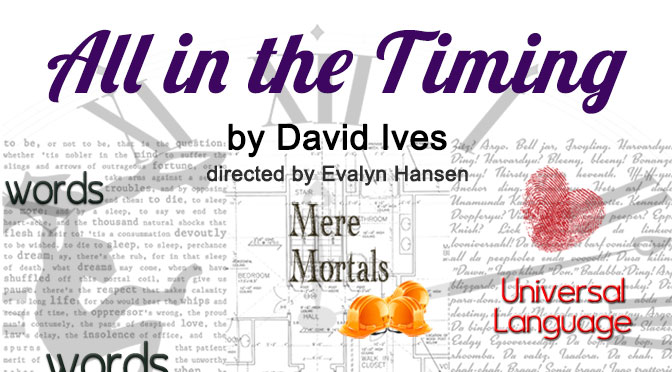
Ashland Contemporary Theatre leaps into fall with “All in the Timing,” three sparkling and savvy comedies by David Ives.
“Words, Words, Words” ponders the pseudo-science truism: that monkeys might write Shakespeare’s “Hamlet” if given enough time. “Mere Mortals” discovers our loftier selves on the fiftieth floor. “The Universal Language” leads us through labyrinths of language expressing its own moniker of love.
Directed by Evalyn Hansen and featuring a stellar cast, “All in the Timing” plays for two weekends:


 Ashland Theatre