Southern Oregon University’s production of “The White Fugue” is devised and directed by James Donlon, a member of the Theatre Arts faculty. Donlon is an internationally celebrated theater artist and teacher of physical theater. We met in his office on the SOU campus.
EH: What attracts you to the field of mime?
JD: As a mime, your purpose is to transform time and space with only your body. Mime is a poetic form to condense and economize themes into an essential place, and to put commentary on it. It can be silent, or it can be verbal. Language becomes a gesture, maybe just sounds, gibberish or vocal effects. In today’s American culture, people don’t really understand the world of mime. The term “mime” is usually the butt of jokes, such as “the birthday mime” or “Let’s kill the mime.”
Dr. Eric Levin, an associate professor of theater arts, supervises Southern Oregon University’s Master of Theatre Studies in Production and Design Program. The candidates, high school teachers from all over the world, converge on SOU for two weeks each summer to pursue a degree while developing their skills in technical theater. Levin and I chatted in his office on the SOU campus one summer afternoon.
EH: Tell me about the production and design program.
EL: It’s a year-round program that meets during the summer. High school theater teachers learn how to design and build plays. Most high school drama teachers need more education in production and design. Some come in with very little theater experience outside of their own programs.
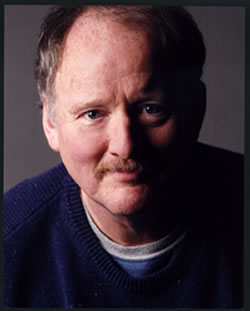
Michael Maag is the lighting and projection department manager at the Oregon Shakespeare Festival. Maag has been fascinated with theatrical lighting and design since high school. After achieving a bachelor’s degree in technical theater, he traveled as an actor, a stunt man and fight coordinator, designed lights for theaters and planetariums, and then came to OSF to pursue the love of his life. We chatted in his office behind the stage of the Elizabethan theater.
EH: How do you design lighting for a play?
MM: When reading a play, the first thing that you start with is time, place, motion, where we are, when we are, how we’re moving from place to place. Then there is the overall idea — what is the piece about? What is the underlying meaning of this piece? Why are we doing this play? It’s not only what the playwright has as the underlying meaning of the work, why they wrote the play, but why this director is doing it, what their concept is, and why is it that the Oregon Shakespeare Festival chose to do this play at this time. All of that gets layered in. Then the job is to take the concept and to find a way with light to reinforce and to help tell the story. If we’re doing the “Scottish play” (“Macbeth”), and the play is all about blood, we want to establish lighting that helps make that blood stand out. So, we’ll have stark white, cool light that is in stark contrast to the deep red that is on the other side of the color spectrum, until we need the bloody scenes, and then we light it with red to emphasize it. So that we’re always getting your eye ready for what is going to happen.
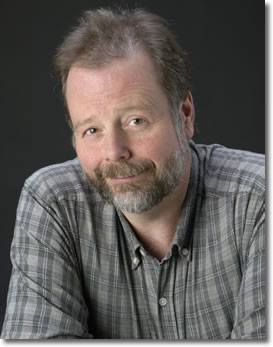
Theatre Arts professor emeritus Dennis Smith has directed more than 30 plays during his 28-year career at Southern Oregon University. Currently he is directing Tony Kushner’s “The Illusion,” based loosely on the play “L’Illusion Comique” by the 17th-century playwright Pierre Corneille. It’s the story of a father who enlists a magician to search for his long-lost son. The play is filled with visions, transformations, time shifts and twists of fate. I visited with Smith at his office in the Theatre Arts Department one afternoon.
EH: Tell me about the qualities of the adaptation.
DS: The style is very contemporary. Tony Kushner has made the characters very accessible, highly articulate and in tune with our contemporary ears.
Southern Oregon University Theatre Arts Professor Chris Sackett is directing “Avenue Q,” a Tony Award-winning musical that opens Thursday, May 16, at SOU’s Center Stage Theatre. Sackett and I walked to the Stevenson Union on the SOU campus to discuss “Avenue Q.”
CS: It’s smart; it’s fun. It’s rife with political satire and irony; that’s part of the attraction of the play. The humor at times is extremely biting; sometimes it is coarse; but it all holds together pretty well. Overall, it’s really smart how they’ve taken this irreverent approach to a deep reverence for the human condition, and how we might pragmatically have a greater scope of tolerance for our fellows.
EH: What’s the message of “Avenue Q”?
CS: Get over self-pity; quit thinking about yourself, and get engaged with life.
Michael J. Hume, along with Jahnna Beecham and Malcolm Hillgartner, wrote “Dogpark: The Musical” now playing at Oregon Cabaret Theatre. The trio has written other musicals, including “Holmes and Watson Save the Empire,” which Hume directed. He is currently in rehearsal for “The Heart of Robin Hood” and “A Midsummer Night’s Dream” at the Oregon Shakespeare Festival. We chatted one afternoon about the process of writing musicals with friends.
MH: It was like “Singing in the Rain.” Malcolm would be on the piano; we could just sit there writing songs and creating riffs. Then I’d come home and write, and we’d send computer stuff back and forth.
EH: It’s nice that you can collaborate; writing alone can be daunting.
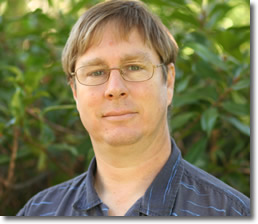
Southern Oregon University associate professor David McCandless is directing the premiere of his play “Invisible Threads,” which opens Thursday in SOU’s Center Stage Theatre. We chatted in his office in the Theatre Arts Department.
DM: The premise is, a mysterious figure recruits some down-on-their-luck actors to apply their thespian skills to rescue some people from real-life crises. It preys upon that ethic angst that a lot of actors have: that they’re not contributing to the world; that they’re not really doing anything to help people; and that they’re just indulging themselves.
It explores the thin border between illusion and reality. It has to do with that theater and life continuum. It’s meant to be an examination of role-playing and identity, and the joys and the limits of theater.



 Ashland Theatre